A View From Outside the Box
Here’s a confession: the person who most captured my imagination during the 2004 American presidential campaign was Teresa Heinz Kerry. She was attractive, out-spoken, and very, very rich. And her job was to distribute the assets of the Heinz Family Foundation in ways most calculated to benefit humanity. How cool was that? Wow, I thought, I wish I could be a billionaire--I wish being a philanthropist was my job! It didn’t seem like a reasonable goal at the time, but it was heartfelt.
That wish came true.
To be completely honest, I’m a billionaire in terms of Vietnamese currency (at an exchange rate of 16,000 Vietnamese dong to one US dollar), and I don’t draw a salary in my new role as “professional philanthropist”—but I do run a US-registered non-profit organization from my new home in Vietnam. I am certainly rich by Vietnamese standards and my family lives quite comfortably here, while I am free to do the work of my new organization: Steady Footsteps. How cool is that?
What would you do if you realized that, compared to most of the world’s population, you were very rich indeed? What would you do if you decided that the things that you were clinging to –job security, rising home equity, readily available health care, and a democratic government—were illusory? Would you hold fast to your present lifestyle—or would you consider doing something “radical”?
American Physical Therapist Runs Amok
September 15, 2007
Well, here’s something I didn’t see coming: I’m now doing speech therapy for Vietnamese patients. How strange is that?
I’m not an Occupational Therapist, but I play one in Vietnam. Now, it appears that, by default, I’m playing Speech Therapist as well. Weird, when you think about it, especially since I can barely pull together enough Vietnamese to order banana pancakes and tea in the morning! More prosperous countries have highly trained, experienced physical, occupational and speech therapists. Here, in Central Vietnam, minimally qualified PTs are the only therapists patients will ever see. There just aren’t any OTs or speech therapists here.
Lately, I’ve been luring therapists and patients away from the high, narrow treatment tables of the crowded “PT” area of the hospital and into the newly provided “OT” room in order to get them to try more functional upper extremity activities. There, we work on hand-eye coordination, trunk stability, combination hand-and-arm movements, and bilateral upper extremity function. Having a cabinet full of donated wooden puzzles has allowed us to see that some of the non-verbal patients have pretty sophisticated problem-solving abilities. We’ve also uncovered previously undetected visual and perceptual deficits in this setting. We check patients’ ability to follow verbal commands versus visual demonstrations. Today we experimented with one-step and two-step commands to look into memory issues. And we asked some patients to verbalize about their activities--what color is this?—and so forth. I couldn’t do any of this, of course, without Mieng, my trusty translator. This weekend, Mieng is stocking up on large-print and picture books, markers and notepaper. We’re going to see what we can do with a post-meningitis patient who, we now realize, has double vision and a stroke patient with right-sided paralysis who has word-finding issues and difficulty reading.
I always urge my student therapists to take a functional approach when evaluating and treating their patients. But “activities of daily living” in Vietnam do not necessarily equate with ADLs in my former home country of America. Today, for example, I learned I’ve been operating under a mistaken assumption. I didn’t realize that most families in Vietnam sit and eat their meals on the floor. Many of our patients have difficulty feeding themselves in the hospital when they sit perched on the edge of their bed, without a table in front of them. I thought that issue would be resolved once they returned home, as long as the family ensured that they sat in a chair at the family table. Not necessarily true, if there’s no table or chair at home, eh?
Earlier, I was stunned when a right-handed woman with a paralyzed left arm told me that she could not eat rice.
“Why not?” I asked.
“Obviously,” she told me, “because I can’t hold my rice bowl in my left hand!”
I thought, at the time, that I’d resolved that issue by instructing her to set the bowl on a table with a little piece of rubber mesh under it to prevent it from sliding around while she scooped up rice using a spoon in her good right hand. Now I realize that she probably never eats at a table at all.
Live and learn.
Well, here’s something I didn’t see coming: I’m now doing speech therapy for Vietnamese patients. How strange is that?
I’m not an Occupational Therapist, but I play one in Vietnam. Now, it appears that, by default, I’m playing Speech Therapist as well. Weird, when you think about it, especially since I can barely pull together enough Vietnamese to order banana pancakes and tea in the morning! More prosperous countries have highly trained, experienced physical, occupational and speech therapists. Here, in Central Vietnam, minimally qualified PTs are the only therapists patients will ever see. There just aren’t any OTs or speech therapists here.
Lately, I’ve been luring therapists and patients away from the high, narrow treatment tables of the crowded “PT” area of the hospital and into the newly provided “OT” room in order to get them to try more functional upper extremity activities. There, we work on hand-eye coordination, trunk stability, combination hand-and-arm movements, and bilateral upper extremity function. Having a cabinet full of donated wooden puzzles has allowed us to see that some of the non-verbal patients have pretty sophisticated problem-solving abilities. We’ve also uncovered previously undetected visual and perceptual deficits in this setting. We check patients’ ability to follow verbal commands versus visual demonstrations. Today we experimented with one-step and two-step commands to look into memory issues. And we asked some patients to verbalize about their activities--what color is this?—and so forth. I couldn’t do any of this, of course, without Mieng, my trusty translator. This weekend, Mieng is stocking up on large-print and picture books, markers and notepaper. We’re going to see what we can do with a post-meningitis patient who, we now realize, has double vision and a stroke patient with right-sided paralysis who has word-finding issues and difficulty reading.
I always urge my student therapists to take a functional approach when evaluating and treating their patients. But “activities of daily living” in Vietnam do not necessarily equate with ADLs in my former home country of America. Today, for example, I learned I’ve been operating under a mistaken assumption. I didn’t realize that most families in Vietnam sit and eat their meals on the floor. Many of our patients have difficulty feeding themselves in the hospital when they sit perched on the edge of their bed, without a table in front of them. I thought that issue would be resolved once they returned home, as long as the family ensured that they sat in a chair at the family table. Not necessarily true, if there’s no table or chair at home, eh?
Earlier, I was stunned when a right-handed woman with a paralyzed left arm told me that she could not eat rice.
“Why not?” I asked.
“Obviously,” she told me, “because I can’t hold my rice bowl in my left hand!”
I thought, at the time, that I’d resolved that issue by instructing her to set the bowl on a table with a little piece of rubber mesh under it to prevent it from sliding around while she scooped up rice using a spoon in her good right hand. Now I realize that she probably never eats at a table at all.
Live and learn.
HELMETS IN THE NEWS
August 31, 2007
Two years ago, as we sat in a little restaurant in Da Nang, Vietnam, the proprietor walked up and offered us his sincere condolences on the unfolding tragedy in New Orleans. That’s how we learned about Hurricane Katrina. George Bush, apparently, didn’t get the message until some time later.
We were visitors to Vietnam in 2005, just finishing up a short stint as Health Volunteers Overseas (HVO) volunteers at a rehabilitation center in Da Nang. Now, here we are, two years later, living and working in Vietnam and participating in a great national effort to stem the rising tide of death and disability resulting from motorbike accidents.
There are, today, 3401 employees of the Da Nang Department of Health who wear helmets provided by Steady Footsteps to work every day. They do this in order to protect themselves and because their co-workers wear helmets, too. But—bottom line—they do it because the Da Nang Health Department now mandates helmet use and employees may not report to work without them. This is the essence of the agreement that we signed with the Department of Health: Steady Footsteps would supply the helmets if the DOH would mandate their use.
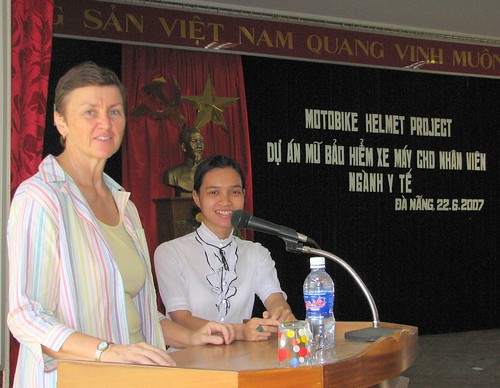
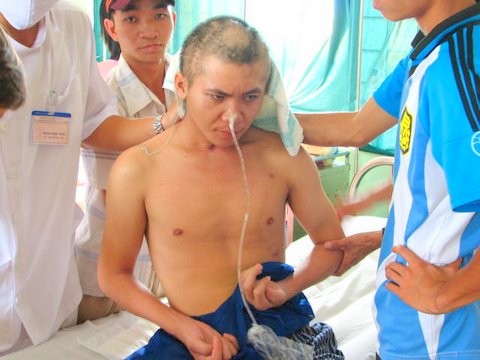
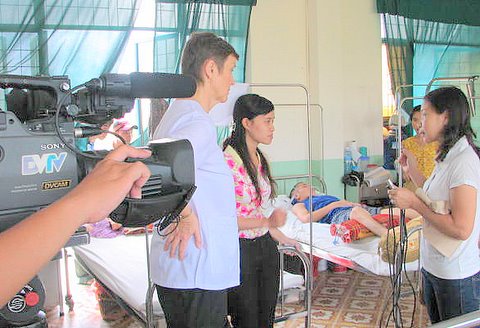
Beyond the immediate effect of ensuring the safety of those 3401 employees, however, this project serves as a model for other governmental groups and businesses. Our project has been featured repeatedly on Da Nang TV News, as well as VTV1, based in Hanoi. Footage of my address to the officials of the Department of Health (my mouth moves, but the TV anchor supplies the words), images of brain-injured patients at the Da Nang Rehabilitation-Sanatorium Hospital, and interviews with helmet-wearing workers arriving at Da Nang General Hospital are combined with media exhortations to be safe and wear a helmet.
On the horizon, now, is a new national law which will mandate helmet use by all motorbike riders by the end of this year--an enormous milestone in a nation where 38 people die and many more are permanently disabled every day in traffic accidents. Compliance, though, is not guaranteed. To that end, the next project for the Steady Footsteps crew is to translate and print booklets based on the text of my August 5 post and then to distribute them to the 30,000 students of the University of Da Nang. We thought we’d back up the letter of the law with some vivid descriptions of what happens if your brain is injured—but you survive. We’re planning to include a University of Da Nang helmet sticker with each booklet. These high-achieving universty students are role models for all the younger kids. Whatever they do—whether they flaunt the law or wear their helmets proudly--will have an enormous effect on what other young people decide to do.
The $25,564 USD cost of the Department of Health Helmet project took a big chunk of our personal savings. Printing up 30,000 booklets and stickers is going to take even more. Any contribution you might feel led to make to Steady Footsteps to help in this work would be hugely appreciated. It is a rare and wonderful thing to be able to make this big an impact on a society. Please consider helping us to continue in this work.

Two years ago, as we sat in a little restaurant in Da Nang, Vietnam, the proprietor walked up and offered us his sincere condolences on the unfolding tragedy in New Orleans. That’s how we learned about Hurricane Katrina. George Bush, apparently, didn’t get the message until some time later.
We were visitors to Vietnam in 2005, just finishing up a short stint as Health Volunteers Overseas (HVO) volunteers at a rehabilitation center in Da Nang. Now, here we are, two years later, living and working in Vietnam and participating in a great national effort to stem the rising tide of death and disability resulting from motorbike accidents.
There are, today, 3401 employees of the Da Nang Department of Health who wear helmets provided by Steady Footsteps to work every day. They do this in order to protect themselves and because their co-workers wear helmets, too. But—bottom line—they do it because the Da Nang Health Department now mandates helmet use and employees may not report to work without them. This is the essence of the agreement that we signed with the Department of Health: Steady Footsteps would supply the helmets if the DOH would mandate their use.
Beyond the immediate effect of ensuring the safety of those 3401 employees, however, this project serves as a model for other governmental groups and businesses. Our project has been featured repeatedly on Da Nang TV News, as well as VTV1, based in Hanoi. Footage of my address to the officials of the Department of Health (my mouth moves, but the TV anchor supplies the words), images of brain-injured patients at the Da Nang Rehabilitation-Sanatorium Hospital, and interviews with helmet-wearing workers arriving at Da Nang General Hospital are combined with media exhortations to be safe and wear a helmet.
On the horizon, now, is a new national law which will mandate helmet use by all motorbike riders by the end of this year--an enormous milestone in a nation where 38 people die and many more are permanently disabled every day in traffic accidents. Compliance, though, is not guaranteed. To that end, the next project for the Steady Footsteps crew is to translate and print booklets based on the text of my August 5 post and then to distribute them to the 30,000 students of the University of Da Nang. We thought we’d back up the letter of the law with some vivid descriptions of what happens if your brain is injured—but you survive. We’re planning to include a University of Da Nang helmet sticker with each booklet. These high-achieving universty students are role models for all the younger kids. Whatever they do—whether they flaunt the law or wear their helmets proudly--will have an enormous effect on what other young people decide to do.
The $25,564 USD cost of the Department of Health Helmet project took a big chunk of our personal savings. Printing up 30,000 booklets and stickers is going to take even more. Any contribution you might feel led to make to Steady Footsteps to help in this work would be hugely appreciated. It is a rare and wonderful thing to be able to make this big an impact on a society. Please consider helping us to continue in this work.

Traumatic Head Injury As Literary Device
August 5, 2007
I wrote this essay in response to
the shock and dismay I felt when I learned that helmet laws in America
are being systematically challenged and rescinded through the work of
(fill-in-expletive-here) who utilize the internet to spread
disinformation claiming, among other things, that helmets are dangerous.
I learned about traumatic head injuries in the usual way—by watching Saturday morning cartoons. I learned from Tom and Jerry that, if an anvil drops on your head, a tall bump will immediately emerge and little chirping birds will circle about your head until the next scene, when you will be fully recovered and ready to chase that mouse again. I learned more from watching movies. I learned that a blow to the head could cause amnesia—which could only be reversed by another blow to the head. And, as any fan of action flicks knows, a sharp thump to the back of the head will knock the hero out, but he’ll awaken 30 to 60 minutes later (whatever the plot demands) ruefully rubbing his head and muttering, “What happened?”
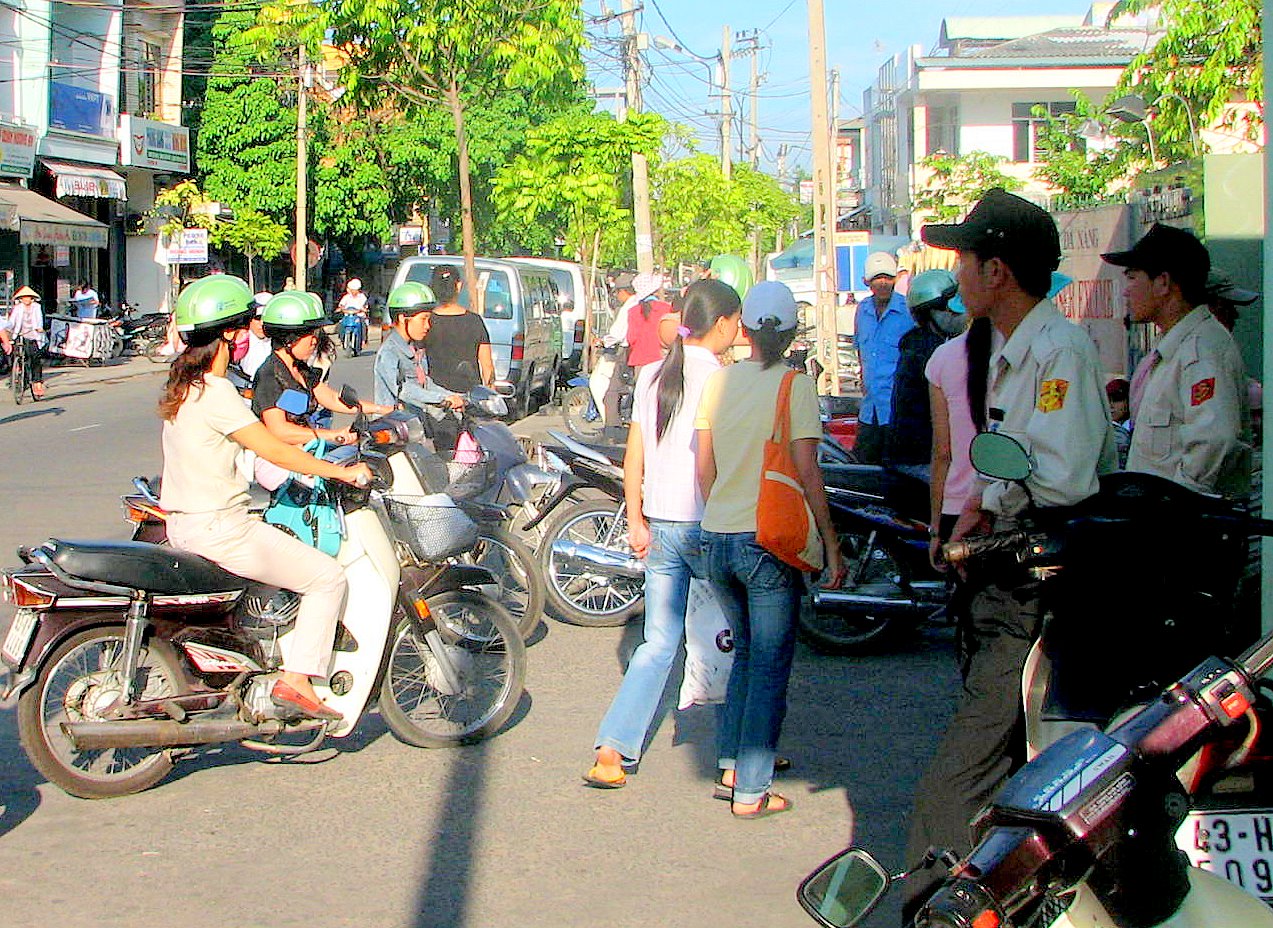
I didn’t learn much more about head injuries until I went to physical therapy school. I learned even more by working with head-injured patients over the next thirty years. Now I live in Vietnam, where traumatic head injury is one of the leading causes of death and disability. This is because, in Vietnam, motorbikes comprise 90 percent of road traffic and helmet use is rare. Thirty-eight people die everyday in Vietnam in traffic accidents—mostly head injuries from motorbike mishaps. But many, many more suffer head injuries and survive. Those survivors fill the hospitals and rehabilitation centers in Vietnam.
Phuong was a bright high school student--one of the few in Da Nang who was fluent in English and confident enough to speak to American and Australian visitors. One day she slipped off the back of her boyfriend’s bike and struck her head against the pavement. Now, a year and a half later, she can walk again and her hair has grown in enough to camouflage the deep depression in her head where her scalp lies directly over the right half of her brain. She even recalls a few words of English. If she concentrates really hard, she can stand at the sink and wash dishes under her mother’s supervision. But her bright academic and professional future is gone now and her mother has grown to accept the idea that her once brilliant daughter will always remain an impulsive child.
Dr. Lam has spent the three years since his motorbike accident searching for the Holy Grail—a therapy that would give him back the use of his left hand so that he could resume his work as a surgeon. Ours was the third rehab center he had tried. He arrived with his youngest son in attendance and was delighted to find a foreign-trained therapist. He offered me his wizened left hand to examine. “I’m so sorry,” I said, “but when we see no evidence of muscle return after all this time, I have to say that I see no hope that you can regain enough use of your hand to do surgery again.” I talked to him, instead, about teaching medical students those skills that he could no longer perform himself.
Mr. Cuong was an engineer and the father of three until a van made a right turn from a left lane and knocked him from his motorbike. His younger sister has been by his side for the three months he’s been hospitalized, while his wife cares for their children at home. His sister spoon-feeds him soup between his chokes and sputters. His progress in therapy has been slowed by recurrent bouts of pneumonia, caused by his inability to consistently direct food into his stomach instead of his lungs. Mr. Cuong can’t speak and can’t understand verbal commands either, which makes teaching him exercises and understanding his concerns difficult. One day last month, his sister, his therapist, a student therapist, my translator and I encircled him as he sat in a straight-backed chair and tried to puzzle out why he appeared to be so agitated. Failing that, we elected to go on to the most basic non-verbal exercise I know: Stand Up! With his therapist on one side and me on the other, we hollered, “MOT, HAI, BA!” and hoisted him up onto his feet. Mr. Cuong grimaced and grunted and stood up--and dropped a steaming load of shit from his shorts onto the floor. Nervous giggles all around. Oh. That’s what he wanted to say.
I learned about traumatic head injuries in the usual way—by watching Saturday morning cartoons. I learned from Tom and Jerry that, if an anvil drops on your head, a tall bump will immediately emerge and little chirping birds will circle about your head until the next scene, when you will be fully recovered and ready to chase that mouse again. I learned more from watching movies. I learned that a blow to the head could cause amnesia—which could only be reversed by another blow to the head. And, as any fan of action flicks knows, a sharp thump to the back of the head will knock the hero out, but he’ll awaken 30 to 60 minutes later (whatever the plot demands) ruefully rubbing his head and muttering, “What happened?”
I didn’t learn much more about head injuries until I went to physical therapy school. I learned even more by working with head-injured patients over the next thirty years. Now I live in Vietnam, where traumatic head injury is one of the leading causes of death and disability. This is because, in Vietnam, motorbikes comprise 90 percent of road traffic and helmet use is rare. Thirty-eight people die everyday in Vietnam in traffic accidents—mostly head injuries from motorbike mishaps. But many, many more suffer head injuries and survive. Those survivors fill the hospitals and rehabilitation centers in Vietnam.
Phuong was a bright high school student--one of the few in Da Nang who was fluent in English and confident enough to speak to American and Australian visitors. One day she slipped off the back of her boyfriend’s bike and struck her head against the pavement. Now, a year and a half later, she can walk again and her hair has grown in enough to camouflage the deep depression in her head where her scalp lies directly over the right half of her brain. She even recalls a few words of English. If she concentrates really hard, she can stand at the sink and wash dishes under her mother’s supervision. But her bright academic and professional future is gone now and her mother has grown to accept the idea that her once brilliant daughter will always remain an impulsive child.
Dr. Lam has spent the three years since his motorbike accident searching for the Holy Grail—a therapy that would give him back the use of his left hand so that he could resume his work as a surgeon. Ours was the third rehab center he had tried. He arrived with his youngest son in attendance and was delighted to find a foreign-trained therapist. He offered me his wizened left hand to examine. “I’m so sorry,” I said, “but when we see no evidence of muscle return after all this time, I have to say that I see no hope that you can regain enough use of your hand to do surgery again.” I talked to him, instead, about teaching medical students those skills that he could no longer perform himself.
Mr. Cuong was an engineer and the father of three until a van made a right turn from a left lane and knocked him from his motorbike. His younger sister has been by his side for the three months he’s been hospitalized, while his wife cares for their children at home. His sister spoon-feeds him soup between his chokes and sputters. His progress in therapy has been slowed by recurrent bouts of pneumonia, caused by his inability to consistently direct food into his stomach instead of his lungs. Mr. Cuong can’t speak and can’t understand verbal commands either, which makes teaching him exercises and understanding his concerns difficult. One day last month, his sister, his therapist, a student therapist, my translator and I encircled him as he sat in a straight-backed chair and tried to puzzle out why he appeared to be so agitated. Failing that, we elected to go on to the most basic non-verbal exercise I know: Stand Up! With his therapist on one side and me on the other, we hollered, “MOT, HAI, BA!” and hoisted him up onto his feet. Mr. Cuong grimaced and grunted and stood up--and dropped a steaming load of shit from his shorts onto the floor. Nervous giggles all around. Oh. That’s what he wanted to say.
Identity Shift
August 4, 2007
Another essay written while I attended the Iowa Summer Writing Festival last month.
A year ago, my American family and I crossed the international date-line and stepped into Vietnam with new identities.
My Vietnamese-born son was raised in the US and speaks only English. In crossing that line and returning to the land of his birth, his identity shifted from “short, funny, confrontational Asian dude” to “tall, rich, good-looking mute American.”
My tongue-tied, under-employed house-husband became a strong, silent American philanthropist.
And I, a relatively tall, middle-class, politically progressive physical therapist, became a gigantic, wealthy, authority figure with an enviable nose.
It’s an odd experience to have lovely, leggy Vietnamese barmaids walk up to me and stroke my nose in admiration. Odder still to have become a frequent guest lecturer at the University of Da Nang, based solely on my ability to speak English fluently. I’ve become a valued resource for international humanitarian groups and traveling surfers—just because of where I live.
What determines value? Location, location, location!
Another essay written while I attended the Iowa Summer Writing Festival last month.
A year ago, my American family and I crossed the international date-line and stepped into Vietnam with new identities.
My Vietnamese-born son was raised in the US and speaks only English. In crossing that line and returning to the land of his birth, his identity shifted from “short, funny, confrontational Asian dude” to “tall, rich, good-looking mute American.”
My tongue-tied, under-employed house-husband became a strong, silent American philanthropist.
And I, a relatively tall, middle-class, politically progressive physical therapist, became a gigantic, wealthy, authority figure with an enviable nose.
It’s an odd experience to have lovely, leggy Vietnamese barmaids walk up to me and stroke my nose in admiration. Odder still to have become a frequent guest lecturer at the University of Da Nang, based solely on my ability to speak English fluently. I’ve become a valued resource for international humanitarian groups and traveling surfers—just because of where I live.
What determines value? Location, location, location!
VORTEX
August 4, 2007
I was sucked into the Vortex gift shop one Sunday evening while I was visiting Iowa City. I returned again on Monday to make sure I had not dreamed it.
The Vortex is exactly the sort of clever, crafty gift shop where I would once have stood and agonized over which clever novelty gift to get for whom. Who would best appreciate the Marie Antoinette action figure with “ejector-action” head? Could the Nelson Mandela combination finger puppet/refrigerator magnet be given alone, or would it go better, perhaps, with Joan of Arc or Karl Marx? Would a $2.95 tin of peach-flavored “ImpeachMints” with an enameled image of GW Bush make a nice stocking stuffer? Maybe the box of “IndictMints” with VP Cheney and Karl Rove in black and white prison garb would be a better choice?
These whimsical novelties still tickle me, but the context of my life has shifted dramatically since last I perused an American gift shop. My refrigerator now is in Da Nang, Vietnam. And the friends who visit me in my home, while they can speak and understand basic English, would be completely mystified by these artifacts of American culture. And, even if I could, with painstaking effort, explain the elements which combine to make these visual jokes work—there is absolutely no way that I could explain why I had seen fit to spend the equivalent of a month’s school tuition just to make a joke by purchasing an item that has no practical use.
The joke implied in the purchase of these items is that we feel that we are exposing the superficiality of American consumer culture. The larger joke, of course, is that we are making our statement by buying more stuff. Read the small print on each package. It says, “Made in China.” Who’s laughing now?
I was sucked into the Vortex gift shop one Sunday evening while I was visiting Iowa City. I returned again on Monday to make sure I had not dreamed it.
The Vortex is exactly the sort of clever, crafty gift shop where I would once have stood and agonized over which clever novelty gift to get for whom. Who would best appreciate the Marie Antoinette action figure with “ejector-action” head? Could the Nelson Mandela combination finger puppet/refrigerator magnet be given alone, or would it go better, perhaps, with Joan of Arc or Karl Marx? Would a $2.95 tin of peach-flavored “ImpeachMints” with an enameled image of GW Bush make a nice stocking stuffer? Maybe the box of “IndictMints” with VP Cheney and Karl Rove in black and white prison garb would be a better choice?
These whimsical novelties still tickle me, but the context of my life has shifted dramatically since last I perused an American gift shop. My refrigerator now is in Da Nang, Vietnam. And the friends who visit me in my home, while they can speak and understand basic English, would be completely mystified by these artifacts of American culture. And, even if I could, with painstaking effort, explain the elements which combine to make these visual jokes work—there is absolutely no way that I could explain why I had seen fit to spend the equivalent of a month’s school tuition just to make a joke by purchasing an item that has no practical use.
The joke implied in the purchase of these items is that we feel that we are exposing the superficiality of American consumer culture. The larger joke, of course, is that we are making our statement by buying more stuff. Read the small print on each package. It says, “Made in China.” Who’s laughing now?
Subscribe to:
Posts (Atom)