Two New Artists


One of the unexpected joys of living and working in Vietnam has been in having the opportunity to meet and encourage two young artists: Nguyen Tan Hien and Ho Viet Phuong. Hien and Phuong were both university students-- Hien, studying mathematics in his home town of Buon Ma Thuot, and Phuong, studying architecture in Ho Chi Minh City--until they became quadriparetic (weak in all four limbs) due to spinal cord damage--Hien, having been struck by a bus while riding his bicycle, and Phuong, due to a spinal cord tumor. When our paths crossed on the spinal cord unit of the Da Nang Rehabilitation-Sanatorium Hospital, I noticed that they were spending much of their free time, between their daily physical therapy sessions, drawing. While my husband Dave (who is an artist himself) and I saw real talent in these early drawings, the young men dismissed our compliments, saying that they knew they could only become “real” artists if they were able to get admitted into a university art program and learn to create art “correctly.”


Dave and I decided we needed to convince these guys that they had real talent—even though they lacked art school diplomas. So we commissioned Hien to create some pencil sketches for Steady Footsteps greeting cards and we purchased two of Phuong’s wonderful paper mosaics. As Hien began painting in watercolors and--later--acrylics, we bought some of his paintings as well. And every time we had a foreign visitor at the hospital, we took them by Hien and Phuong’s room, which was gradually evolving into a cross between a hospital ward and an art studio. All of the visitors exclaimed over the art work and some took the opportunity to purchase pieces to hang in their homes in Germany, America and Australia. At our suggestion, the proprietors of three local shops: Reaching Out Handicraft Shop of Hoi An; Tam’s Pub and Surf Shop near China Beach; and the Bach Mai Art Gallery at 12 Trung Nu Vuong Street (just across the street from Da Nang's famous Cham Museum) all agreed to carry and sell Hien and Phuong’s work without charging any mark-up.


A few weeks ago, I saw Hien and Phuong wheeling themselves up the street toward the city bus stop. They said they were “on a business trip”—off to meet with a shopkeeper in the neighboring town of Hoi An. This week, Hien told me, he is working with yet another patient, trying set up his own website.


Our friends Hien and Phuong now consider themselves professional artists—quite a concept in a country like Vietnam, which is just gradually emerging from a bare subsistence level economy and where 95% of the disabled are unemployed! Dave and I are delighted to have been catalysts in their development—and we’re delighted, as well, to have Hien and Phuong’s drawings, paintings and paper mosaics brightening the walls of our home!


UPDATE: Check out Hien's newest paintings on-line at the Da Nang Artists Company website! 


Taking Stock


The following is the most recent in a succession of my articles published by CommonDreams.org . While the subject of this essay concerns contemporary life in America, I think you can see that my views have been shaped, at least in part, by my life and adventures here in Vietnam.


Published on Monday, July 14, 2008 by CommonDreams.org
Taking Stock
by Virginia Lockett

In America these days, conventional ideas of wealth and security are being turned upon their heads. Large, luxurious cars that once carried us in air-conditioned splendor over well-maintained roads become less seductive with each refueling at today’s elevated prices. Roads and infrastructure crumble before our eyes, as our “common wealth” is siphoned off to pay for weapons and wars and tax breaks for the uber-class. Savings dwindle as stocks and bonds and even the US dollar lose value every day. Family homes have lost so much value that, strictly from an accounting point of view, many Americans would be better off walking away from them, rather than continuing to pour money into monthly mortgage payments. And how rational does the prospect of incurring tens of thousands of dollars of debt to cover the cost of a university education for our progeny or ourselves appear when tens of thousands of Americans are losing their jobs every month?

The American way of life — once described by Vice President Dick Cheney as “non-negotiable” — isn’t working for us anymore. Nor, for the vast majority of us, is it likely to work within the foreseeable future.

So, what’s to be done? Should we, as a nation, invade other sovereign nations in an attempt to control their petroleum assets? That hasn’t worked out well thus far, has it? Should we turn a blind eye to the hungry of the world and press the world’s corn and sugar and soybean fields into service to produce biofuels so that we can continue to motor about in our SUVs? Shall we continue to uphold zoning regulations that prevent laundry lines, vegetable gardens, and small businesses from invading our suburban landscapes? Should we continue burn vast quantities of fossil fuels in order to heat our out-sized homes so that we can step into a 72F body of air whenever we throw back our bedcovers in the morning or return after hours or days spent away from home? How long will we continue to send the kids to day care and pay for the fuel and upkeep on two cars so that Mom and Dad can go to work at jobs that barely pay enough to cover expenses?

What is the “cost of living” anyway? What do we actually need to stay alive? Well, we certainly need a fairly regular supply of fuel for our own bodies-carbohydrates enough to keep our brain and muscle cells operational and some additional nutrients to take care of growth and maintenance and repairs. As we are relatively hairless warm-blooded creatures, we need a little extra help, in the form of clothing and/or shelter, to maintain our optimal body temperature-the 98.6F at which the chemical reactions of life processes occur most readily. And it goes without saying that we need breathable air and drinkable water.

Everything else is gravy.

It’s quite a challenge for any one individual — anywhere in the world — to survive alone. It’s even more difficult to survive unassisted while caring for young children. And that is the basic purpose of community: to help people to survive — by sharing labor, knowledge, skills and resources.

We are awakening now from our long American Dream. The petroleum-fueled, mass-produced lifestyle that Americans have enjoyed for as long as most of us can remember is unlikely to re-manifest itself in the foreseeable future. We need to open our eyes to what survival really requires — and how necessary community is to that survival. In this new America, the neighbor who raises tomato seedlings and can teach us how to grow them in our particular micro-climate may be more relevant to our lives than the Wal-Mart Super Center twelve miles outside of town. The friend who can help us drain down the water pipes in our unheated upstairs bathroom each winter will be infinitely more valuable than a homeowners insurance policy from State Farm. A local farmer with a functional pickup truck, wagon or a hand-cart who is willing to haul produce to an isolated suburban enclave — and those who know how to turn that raw produce into something tasty and nutritious and are willing to share those skills with others — will be central to communities of the future.

Survival will depend, not only upon careful stewardship of our material resources, but also upon cultivation of local sources of knowledge and skill. Most importantly, it will require the nurturing of communities in which we care for one another, in every sense of the word.

Virginia Lockett spent the first 53 years of her life in America. She lives now in Da Nang, Vietnam, where she is happy to eat, sleep, shop, work, and play within the radius defined by the range of her electric motorbike. More about Virginia’s life and work can be gleaned from her blog at www.steadyfootsteps.org


The Ethics of Compassion


This article appeared in the most recent issue of Dispatches,The Newsletter of the International Health Division, Canadian Physiotherapy Association.

The Ethics of Compassion
By Virginia Lockett, PT
President, Steady Footsteps, Inc.

compassion n. Deep awareness of the suffering of another coupled with the wish to relieve it.

I embarked on my career as an American physical therapist over thirty years ago, imbued with a vague sort of idealism and a notion that the field of physical therapy would allow me to use my body, as well as my voice, to teach the most motivated students in the world—people who wanted to regain control over their own bodies.

As a young therapist, youth and inexperience limited my appreciation for the suffering of others. The distress of my patients was, to some degree, an abstraction to me. I could not fully appreciate the distinction between the experience of acute pain, for example, and the dark terror accompanying chronic pain associated with irresolvable physical deterioration and the impending dependence that that might imply. I could not, until I had children of my own, read the anguish in the eyes of the parents of teen-aged accident victims. And I could not fully share in the ambivalent feelings of middle-aged children of frail, aged parents until I had walked a mile in their shoes.

The accrual of life experiences helped me empathize with my patients and their families as I grew older. But something else happened along the way: I became a “professional.” Precise documentation, efficient time management, technical expertise and emotional detachment were considered the hallmarks of a good therapist in the facilities where I worked. Only within the framework of my last American job, where I treated patients in their own homes, and was paid on a per-visit basis, did I feel free to spend extra time and, occasionally, a bit of my own money, to help my patients beyond the role defined by my profession. In essence, it was the first job where I felt I could—on a fairly regular basis—fully exercise my compassion without being viewed as behaving “unprofessionally.”

In 2006, I moved to Da Nang, Vietnam, and established my own NGO, Steady Footsteps, Inc., in order to further exercise that compassion. According to the terms under which my organization is partnered with the Da Nang Rehabilitation-Sanatorium Hospital, if I identify a need—patients lacking walkers or canes or appropriate footwear, for example—it is understood that I, in my capacity as the director of Steady Footsteps, may address that need. I’m not stepping outside my professional mandate—this is part of my role as a humanitarian.

As my schedule is my own, and I do not charge for my services, I can take all the time I wish to address the concerns of a particular patient and family. Because I cannot speak Vietnamese—let alone write it—there is no expectation that I will spend my time producing volumes of documentation, as I did on my American jobs. A side benefit of not sharing a common language with my patients is that every encounter is slowed down by the translation process. And when things slow down, you can see a lot more. It’s much easier to read facial expressions and body language when you’re not constantly engaged in talking, measuring and taking notes. And that’s where compassion has its roots--in our innate ability to read facial expressions and gestures. I read the patients, and they read me. Ironically, because I strive to establish eye contact, use visual demonstrations, and focus on functional activities, I can often elicit better responses from the brain-damaged patients at our rehabilitation facility than can the Vietnamese therapists who tend to rely on verbal instruction and cardinal plane range-of-motion exercises, as the patient lies supine and stares at the ceiling.

 
Many of the patients at our hospital are the same age as our young therapists. Two months ago, they were riding motorbikes to work and to the market, just as these therapists do. They might have passed each other on the street or sat sipping coffee in the same café. A simple motorbike mishap was all it took to set their lives upon a radically different trajectory. It would seem that compassion—if not for the patients, who might now be drooling and inarticulate, then at least for the desperate and ever-present family members who care for their loved ones at the hospital--would be a young therapist’s inevitable response.

But it’s not.

Even in a place where physical therapy skills are rudimentary and where therapists enjoy no particularly elevated status, there’s often a remarkably wide gulf between these white-uniformed professionals and the patients and family members who turn to them for help.

It’s worth considering, I think, as we contemplate the education of young physiotherapists, just what aspects of our profession we want to model and encourage. Did you become a therapist merely in order to demonstrate technical virtuosity and professional detachment? I did not. We may assume that the fact that we are engaged in the “healing arts” is evidence that we are compassionate people. But I invite you to examine once again that definition of compassion at the start of this essay:

compassion n. Deep awareness of the suffering of another coupled with the wish to relieve it.
 
How can we develop “deep awareness of the suffering of another” without being fully present for that human being? Our years of education and experience should certainly inform our assessment and management of the patient’s condition, but they in no way substitute for that “deep awareness” which comes only from paying attention to the patient and his loved ones. “Pathways” and treatment protocols may have their place, but they are no substitute for the compassionate eye and caring touch of an experienced therapist. Let’s make sure that compassion lies at the heart of the legacy we pass on to the next generation of therapists.

Why We're Here (The Long Version)


The seed of the idea that eventually became “Steady Footsteps” was planted in a little house in Nha Trang, Vietnam, in 1995. My husband Dave and I had come to Vietnam to adopt two children and, while we were treading bureaucratic water, a man asked me what my job was. As his English was rudimentary (and he was an English teacher!) and my Vietnamese was non-existent, I explained that my job consisted of helping sick and injured people walk again. “Oh,” replied the teacher, “Here in Vietnam, EVERYBODY does that!” Eventually, however, he invited me to come to his home to meet his father.

His father, who was perhaps 65 years old, was lying in bed, as he had been for five years. His story was this: several years previously, he had been struck by a vehicle which broke his hip. As there was no orthopedic surgery, his hip did not heal, but he was able to hop about on crutches – until, that is, he had a minor stroke which left him unable to use the crutches. Ever since, he had lain in the bed. On special occasions, his son would pick him up in his arms like a baby and carry him to an armchair where the man would sit with tears streaming down his face. Just prior to this medical disaster, the son’s family had been approved to immigrate to Canada. Once the old man became disabled, however, those plans were dashed and the family stayed in Vietnam to care for him.

As I sat on the floor and tried to absorb this information, several thoughts occurred to me. First, although I was an experienced Home Health therapist and considered myself able to “make do” with virtually no specialized equipment and minimal contact with other professionals, there wasn’t much I could do about an old, unhealed hip fracture without access to an orthopedic surgeon. Had this man had his injury in the US or Canada, his hip would have been surgically repaired within 24 hours and, after about six weeks, he would probably have been walking without an assistive device. Then, when he had his stroke, he might have been slowed down a bit but, with a little more therapy, he would most likely have been walking again, perhaps with a cane. Instead, he was bedbound -- without wheelchair, walker or therapist.

Secondly, I was adrift without my most valuable tool: my voice. How to explain to this well-intentioned and guilt-ridden son that his father’s tears most likely resulted from the emotional instability often associated with strokes that affect the left side of the body--not from pain the son was inflicting on that poor old hip? Pantomime can only go so far with abstract concepts.

And, finally, I realized that there must be thousands and thousands of disabled Vietnamese people, spending their lives on floors and in beds, simply because they lack the medical and rehabilitative care that we take for granted in the west.

I didn’t know what I could do about it – but it haunted me.

Fast forward 10 years: an e-mail message from a North American NGO pops up on my computer screen, calling for a volunteer physical therapist to serve as a clinical instructor at the Da Nang Orthopedic and Rehabilitation Center. Whoa! They’ve got orthopedic surgery and physical therapists in Vietnam now! And – crucial for me – they were asking for a clinical instructor, not a stand-up lecturer.

Even with those key elements in place, however, I knew that adaptive aids were still unlikely to be available and affordable in Vietnam. So, as we prepared to return to Vietnam, that was the task allotted to my husband: design and fabricate prototypes of appropriate adaptive devices from inexpensive, locally available materials. AFOs (plastic leg braces) were the one essential item that I thought necessary to import because I had been led to believe none could be fabricated locally. When I queried volunteer therapists returning from Da Nang, they said that, not only were AFOs unavailable, but that they couldn’t be used in Vietnam because everybody wore rubber flip-flops! Likewise they noted that modified forks and spoons were not appropriate because people in Vietnam eat with chopsticks. Really. I don’t think that it’s culturally insensitive to note that sometimes shoes, spoons and forks can be adaptive devices.

 So we loaded up our suitcases with coping saws, brace-and-bits, riveter, reachers, sippy cups, flexible straws and 40 off-the-shelf AFOs. My friend, Barbara Coverdale, an American occupational therapist, devised a wrist splint from chopsticks, fabric, and elastic for Vietnamese tailors to copy. Once we were in Vietnam, Dave spent his time on scavenger hunts in the markets and making prototypes of equipment that we brain-stormed together in our hotel room.  Our best “out-of-the box” idea from that trip was a lap table for quadriplegics fashioned from a plastic sidewalk café table. We merely shortened the legs and cut a semi-circle in one long side. This provided a steadying support and a useful working surface so that the quadriplegics and the non-ambulatory head-injured patients who, at that time, were being discharged home without a wheelchair, could sit up safely and feed themselves in bed or on the floor.


I found it disconcerting to note how ineffective the activities of the Vietnamese therapists were in that facility – especially when I considered that the NGO that I was volunteering with had been sending American and Canadian PTs and OTs there for five years already. Most of the treatments seemed to consist of hot packs (in Vietnam, in July!) and very simple passive exercises performed by the therapist on the patient. Nobody was teaching the patients how to get out of bed and into a chair safely or even how to walk correctly. And because there were only 2 or 3 decrepit wheelchairs in the whole rehab center, families were literally dragging or carrying the patients across an open courtyard to the official “therapy room,” where the physical therapists waited. While I was there, I resolved to focus on functional activities and to clearly articulate my rationale for everything I did. Unfortunately, the promised translator was only intermittently available (and you can’t fake Vietnamese!) and the therapists tended to wander off and leave me to treat the patient alone.

But still, I got hooked. The “gotcha” moment for me came about this way: I had been watching a thin man with dry, cracked skin and his despondent wife out of the corner of my eye for several days. Sometime earlier, a falling wall had broken this man's neck and rendered him paralyzed. Some of his muscles had started to wake up, yet--to my eyes--there was something about him that did not look right. His hands appeared useless, but were not held in a familiar pattern. The big muscles in his legs were barely functioning--but his toes wiggled. This is not how a patient recovering from quadriplegia typically presents. Every day, his therapist would strap boards to the man's knees to hold them straight. Then she and the wife would hoist him onto his feet, and then suspend him by his armpits from some weird, welded-together rolling walking frame. Once standing, he could shuffle along. Finally, it occurred to me that this guy had crutch palsy—paralysis of the arms caused by the pressure of crutches under armpits--a condition I had read about in textbooks, but had never seen in thirty years of practice. Looking closely at this man, it also dawned on me that he was dehydrated and starving.
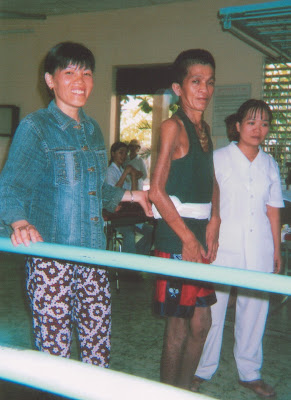
 

In Vietnam, it's the responsibility of the family to feed and provide all personal care for hospitalized patients, but his wife was penniless. His spontaneous recovery from his neck injury was being masked by starvation, dehydration and a new case of crutch palsy. Here’s the cool part: I instructed the therapist to discontinue the “walking exercises” and to work on knee strengthening exercises with him. My husband went out and bought him some bottled water (tap water is not potable in Vietnam), Ensure and canned beans. Two days later, the patient was standing up and walking with minimal assist of the therapist and wife—with no boards or walking frame. Whoa. That’s when I knew I had to come back to Vietnam.

But my husband and I could not figure out how we could afford to travel back and forth between America and Vietnam. Our trip to adopt our children back in 1995 had been funded by money bequeathed to me by my father. The second trip, including the purchase of the AFOs, had been paid for with money left me by my recently deceased aunt. We had run out of elderly relatives, so that funding source was no longer an option. Our only asset was our home. It finally occurred to us that, if we were to sell our home and purchase one-way tickets to Vietnam, we would have enough money to live there modestly, with some left over to fund small projects.

So that’s what we did.

The details are a bit more complicated than that, of course, involving establishing a non-profit organization in the States and finding a suitable Vietnamese governmental entity with which to work--but that's another story.

Here’s the essence of what we’ve learned thus far. Poorly conceived, hit-and-run missions generally miss the mark in Vietnam. The fact that the seats in most rehab clinics in Vietnam are rickety old tub benches sent to a country where bathtubs are rare is one clue.


Orientation literature provided for prospective volunteers at that first rehab center where we worked urges volunteer therapists to prepare a Power Point presentation on an area of their particular expertise. Still, however, that NGO neglects to mention the fact that Vietnamese physical therapists have only two years of the most basic vocational training following high school graduation and that half of that consists of internships under the cursory supervision of therapists who have had that same minimal training. Evaluation and treatment planning are not part of their curriculum. With that sort of introduction and a frequently missing-in action translator, how can a well-meaning short-term volunteer teach effectively?

The fact that an American-based NGO received a $400,000 USD grant from USAID to build a rehabilitation wing onto a private hospital in Da Nang for the express purpose of “demonstrating modern rehabilitation equipment” and that, only as an after-thought, did the director think to contact me to ask if I would care to “volunteer” to be their physical therapist says a lot, too.

 Because we’re here continuously, the veils are gradually lifting from our eyes. And because we’re committed to doing small things that will make a big difference, we do things that you would never see a big NGO do. For example, we buy plastic armchairs for the patient wards and also for families to take home. We buy good quality, Vietnamese-made sport sandals for all the potentially ambulatory patients in our rehab hospital.  We collaborated on the design for, and fund the fitting and production of, a new hinged-ankle AFO, designed to be worn with a sport sandal for neurological patients unable to walk safely due to ankle instablity. We buy rattan canes in order to give patients the confidence they need in order for them to ambulate as well as possible.


What is the point of lecturing about the importance of getting patients out of bed early and often if there are no chairs available? How can you teach someone to pick up their feet if their flip-flops fall off when they do? A rattan cane (complete with tip) costs $2.50 USD, sport sandals are $6.25 and a plastic armchair costs $7. The AFOs are more--but still far, far below what they would be back in the States.

How cool, and how very, very wonderful to be a philanthropist at such budget prices! People are overwhelmingly grateful for these small gifts and – they make a difference! Brain-injured people walk. Stroke patients sit up and look around. I have enormous credibility with family members. And I will tell you, here in Vietnam at least, it is the family members of one patient who teach the next patient’s family how to care for their loved one. Nurses administer IV’s and treat wounds. Therapists “do” exercises and modalities. But it’s the experienced family members who teach the new-comers on the ward how to move and feed and bathe their own disabled son or husband. They’re the ones who are teaching each other how to transfer and position their patients. They’re the ones that are trading feeding tips and helping each other when another set of hands is needed. Winning over these dedicated family members and establishing, through them, new practice on the ward bears fruit. Not only will they be better able to care for their own family members, but they will teach the next group of families. We are establishing what could be called “institutional memory”.

The truth is, my most enthusiastic students are the family members of the patients. In second place are the affiliating physical therapy students from the Da Nang Medical School who, by now, have heard of me from the previous graduating class. Least enthusiastic are some of the physical therapists themselves. It’s not easy, changing old habits. It’s slow going but, with administrative support, persistence and a few “miracle cures,” we are starting to help Vietnamese PTs realize how rewarding and how FUN it can be to be an engaged and effective physical therapist.


The Dark Side of the Mirror


An excerpt from a comment by Usha, made in response to my post of 16 February 2008, Exercising Compassion:

One further thought, regarding the mirror neurons, which I've been reading about quite a bit, lately. It's interesting to me that they're referred to as "Dalai Lama" neurons. I guess that's because they must enable our empathy and compassion. But I've also thought that there is a flip-side to this, for it would seem that mirror neurons must also enable the ignoble "mob mentality," which is not something we'd readily associate with His Holiness.

The raw material of our humanity seems to provide ample potential for the development of both our higher and lower natures. I think it matters a great deal how we cultivate it.

Dear Usha,

You are entirely right, of course, about the “flip-side” of mirror neurons. I’ve been thinking about this a lot recently, especially with the approach of the 40th anniversary of the My Lai massacre, which occurred in nearby Quang Ngai province.

It’s important to realize that each of us does have the capacity to express both the dark side of human nature, as well as something more closely approximating the Divine. And it’s instructive to examine our own lives in order to understand what conditions bring out the best in us and what brings out the worst. For my own part, I note that I am at my best when I feel relaxed and appreciated. When I feel stressed and unloved, I am hard-pressed to put my ideals into practice.

Larry Colburn was an 18 year-old gunner on the helicopter crew that intervened to stop the massacre of unarmed civilians by American troops in My Lai in 1968. In a 2002 interview, he took pains to note the difference in stress levels between his job and that of the troops on the ground. His job, which consisted of drawing enemy fire in order to locate hidden enemy troops was a dangerous one, he noted, but he and his crew slept in relative safety back at base every night. On the other hand, troops in the field remained in harm’s way continuously. It doesn’t excuse the mayhem that those troops exacted on the unfortunate villagers of My Lai, but it is, perhaps, a cautionary note: a combination of unrelenting fear and stress, along with the kind of solidarity fostered by the military can and does trigger the dark side of mirror neurons—the “pack mentality”.

Forty years ago, the American government tried its best to cover up the atrocities committed at My Lai, just as the early reports of prisoner mistreatment by Americans assigned to Iraq’s Abu Ghraib prison were dismissed as “pranks” committed by a few “bad apples”. We’re getting into murky waters these days, when the highest officials of our land condone “enhanced interrogation” techniques and deny any responsibility for the literally uncounted civilian lives destroyed by the reign of destruction in Iraq and Afghanistan. American soldiers are subjected to the unremitting stress of repeated deployments under extremely hostile conditions, while knowing that their often heroic efforts are making no one’s life better. Their superiors consider the Geneva conventions to be “quaint”. Could we design more perfect conditions to bring out the worst in both the Iraqis and the American soldiers? What kind of world is being created here?

While military culture and conditioning is relatively easy to see, at least to those of us standing on the outside, the everyday conditioning to which all Americans are subjected is harder to perceive, at least when you’re sitting in the middle of it. The uncertainty that ordinary Americans experience, living far from any war zone, is in no way comparable to life in Baghdad or Fallujah. It is, nevertheless, unrelenting. Fear-mongering by the Bush administration in the aftermath of September 11th is, perhaps, the most obvious source of that anxiety. Other elements, however, combine to make us feel insecure and thus indisposed to be the best human beings that we can be. Corporate America finds it extremely profitable to conjure up boogeymen for us. Whether your perceived issue is bad breath, financial insecurity, or lack of sex appeal: Corporate America has the cure -- for a price. The backbone of their business plan is the creation of insecurity, which can only be mitigated through the frequent purchase of their products.

We can’t, as individuals, change the way that corporate America and the American government promote their twin messages of insecurity and compulsive consumption. But we can elect to tune those messages out. We can turn off the television and choose to focus instead on creating nurturing communities to replace those that American corporate culture has worked for decades to dismantle. We can work to help those around us feel secure and appreciated. And we can, each of us, strive to model behavior that will make this world one in which we would choose to live.

Opting Out


I am not a saint, although from some folks’ reaction to my personal story, it seems that they see me as such. While it’s true that I do try to be a “clear channel for blessing” as befits my adopted Quaker tradition, that’s not the same thing as being a martyr in the Catholic tradition into which I was born.

Every decision that my husband and I have made in the course of our Vietnam adventure, unconventional though it may have been, can be argued for in pragmatic, or even economic, terms. Selling our home in 2006, for example, and putting the proceeds of the sale into foreign-denominated CDs turns out to have been a pretty shrewd move, in retrospect. Certainly, selling our gas-guzzling vehicles and our oil-heated house does not look too foolish now that oil has reached $100 per barrel!

The monthly rental for our four-story Da Nang townhouse is less than the amount we previously spent for taxes and insurance on our American home. While electricity rates are about the same here as in the States, it doesn’t take much to power our small fridge, lights and electric fans. Likewise, although gasoline prices parallel those in the States, it doesn’t take much fuel to propel our motorbike.

Gone is the perceived need to purchase a myriad of insurance products to protect our assets and our stream of income. Car insurance, life insurance, long- and short-term disability insurance, liability insurance, homeowners and flood insurance—all gone. We opted to relinquish our health insurance also—you can read my thoughts on that issue here.

My husband Dave and I had wrestled for years with the ethical issue of paying taxes to support a government engaged in an illegal war. That dilemma is resolved for us now, as we don’t have an income that reaches a taxable level. And our teen-aged son is beyond the reach of military recruiters and a possible future draft.

Our jobs are history, along with the stress that accompanied them. The cost of living is low enough here in Vietnam that we can and do live off the proceeds of the sale of our home. (We had neither a savings account nor pensions.) Other expatriates that we know live comfortably here on modest pensions. Still others get by on what they earn by teaching English for a few hours a week. Without that constant immersion in the American consumer culture, we find that there isn’t much that we really need to purchase. We got rid of most of our belongings when we moved to Vietnam and we still have an embarrassment of riches.

 My volunteer work here consists of doing the kind of real-deal physical therapy that I dreamed of doing when I first entered physical therapy school back in the 1970s. I’m making a real difference in people’s lives here—without breaking my back and without spending any time at all doing meaningless paperwork! Does that sound like martyrdom to you?

Stepping out of the American rat-race and living a meaning-filled life in a third-world country is NOT impossibly quixotic. I’m here to tell you that it can be a personally gratifying and pretty darned comfortable way to go.

Exercising Compassion


Mirror neurons, asserts neuroscientist V.S. Ramachandran, will be to psychology what DNA is to biology. These so-called “Dalai Lama” neurons, first identified in a lab in Parma, Italy, in 1995, are thought to be key to the human ability to learn skills and language from one another. These are the neurons that enable us to “read” each other’s facial expressions and body language. They’re what cause us to cringe when we watch our child receive an injection or to flush with embarrassment when we witness someone else “play the fool”. When our mirror neurons are in play, we “pick up” on subtle signs of distress from those around us and we are moved to alleviate the cause of that distress. They allow us to experience compassion. Mirror neurons teach us how to behave in community.

While the discovery of mirror neurons is recent, savvy forces have been making use of them for a long time. Totalitarian regimes have always known the importance of squelching demonstrations of dissent. Your mom warned you to stay away from “bad influences.” And there are real economic reasons behind the fact that advertisers pay big bucks to popular figures who model their latest fashions.

It turns out that the motivation behind our behavior is a lot less rational than we would like to believe. Studies show that we are more likely to act in accordance with the behavior that we see modeled around us than we are to act in accordance with our professed beliefs. If this is true, it’s time to examine what we have available to mirror. If you lead a stereo-typical American life, grabbing a pop-tart on the way out the door, driving your auto solo to work, spending the day in an office cubicle, grabbing some fried chicken at the take-out window before sitting down to face whatever the main-stream media has placed before you on the television screen in the evening, who is providing the template for your life?

Some of us feel guilty that we don’t feel more compassion for the “unfortunates” of this world. Others don’t seem bothered and even make derogatory remarks about “rag-heads” and “welfare queens” and “wetbacks”. The plain fact is that it is impossible to feel compassion for an abstraction. What is there to mirror?

If you do feel led to lead a more engaged life, more in keeping with your Christian or Buddhist or Muslim or humanist beliefs, you’ve got to be present; you’ve got to turn your full attention to human beings who are now only abstractions to you.

For me, a big “ah ha!” moment regarding the “homeless situation” was driving up to a Catholic Worker “Breakfast on the Streets” site in Norfolk, Virginia, at seven AM one grey and blustery morning to see one hundred and twenty-five human beings standing quietly in line, each waiting for a cup of coffee, a bowl of boiled grits and two cold hard boiled eggs. Talking with them later, about the misfortunes and ways of thinking that had brought them to this point, I was overwhelmed with the sense that there, but for fortune, could be a child of my own.

For an even easier step, which only involves turning away from your television set and turning towards your computer monitor, I recommend taking a tour of the “Axis of Evil” through the eyes of Andy Chang, a young man who photographed his way across Northern Africa and into the Middle East. Andy’s artistry with a camera allows you to soak in the humanity of the people he met on his journey. Try to hold his images in your mind when next you hear calls to strengthen the American-Israeli position in the Middle East. Think about these faces when you hear terms like “military options” and “collateral damage” discussed.


Working in a Vietnamese rehabilitation hospital as I do, without the benefit of being fluent in Vietnamese, certainly comes with its share of difficulties. Yet many times I feel as if I better appreciate a bereft family member’s despair or a brain-injured man’s confusion when I focus on those individuals directly, rather than relying on my translator's account of their situation.


Your own personal set of mirror neurons can bring you clearly into another’s experience. What, for example, do I have to tell you about this man, in order for you to empathize with his situation?


 You are already wired to be a compassionate human being. It’s up to you to “exercise” your compassion.